
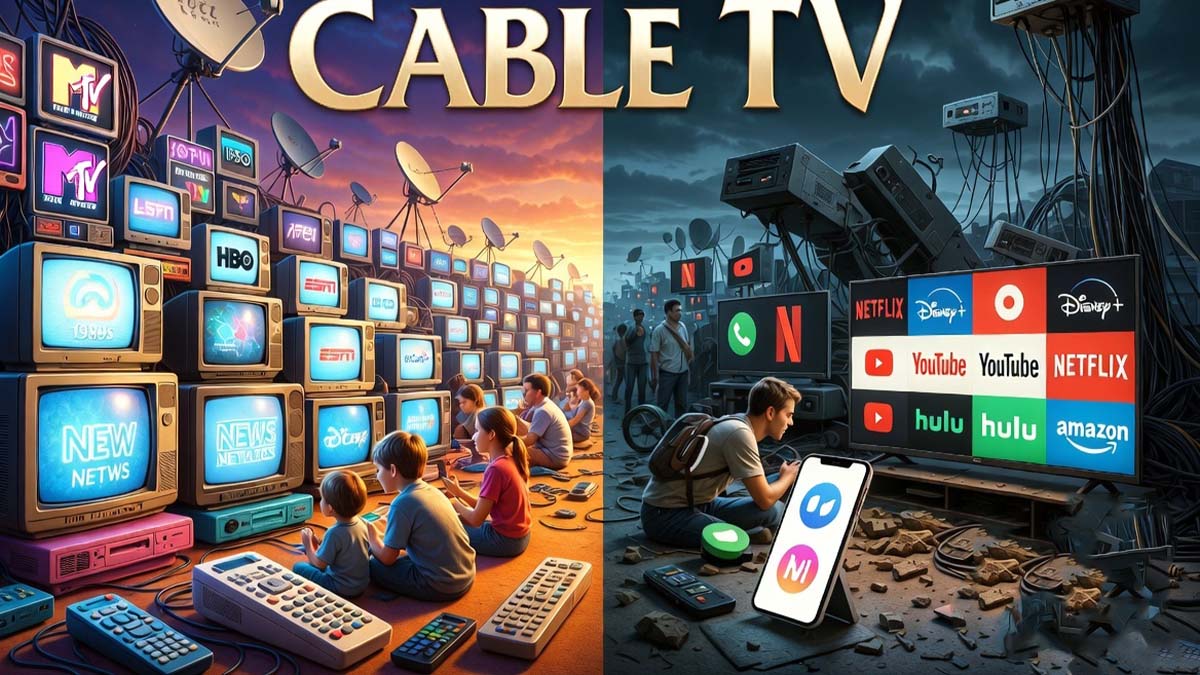
The journey of Cable TV has been like a blockbuster movie—an explosive beginning, a long reign, and now a dramatic climax where old technology is surrendering to the new digital wave. Here’s the complete “Rise and Fall of Cable TV” with the latest data.
Cable TV started in 1948 in rural America and, by the 1980s and 90s, it had become the king of living rooms across the world.
Where people once had only 3–4 government or broadcast channels, cable introduced hundreds of options like MTV, CNN, HBO, and Discovery.
Cable companies maximized profits for decades by bundling internet, phone, and TV services together.
The downfall began when internet speeds improved and platforms like Netflix entered the scene. This shift was called “cord-cutting”—people literally cutting the cable cord and moving online.
Rising cable prices and paying for unwanted channels started frustrating consumers.
Streaming changed everything—you can watch anything, anytime—while cable forces you to wait for scheduled programming.
Recent reports clearly show how fast cable TV is declining:
In May 2025, a historic shift occurred when streaming reached a 44.8% share of TV usage—higher than cable (24.1%) and broadcast (20.1%) combined.
By December 2025, cable TV’s share dropped to an all-time low of 20.2%.
Only 16% of adults under 30 are still using cable TV.
Industry leaders saw this shift coming long ago:
Bob Iger (Disney CEO) warned in 2022 that “linear TV is heading toward a cliff and will be pushed off… I don’t know exactly when it will end, but it is going away.” By 2024, he admitted that the traditional TV business model is “completely broken.”
Reed Hastings (Netflix Co-founder) predicted years ago that “linear TV (scheduled TV) will disappear completely by 2030.”
Ted Turner (Founder of CNN) once hinted at the future by saying he prefers to invest in the future of humanity rather than outdated systems.
Cable companies are now reinventing themselves as internet providers. They are no longer just selling channels—they are selling high-speed data for streaming.
By 2026, around 50 smaller cable companies are expected to shut down, signaling that only large players who adapt to streaming will survive.